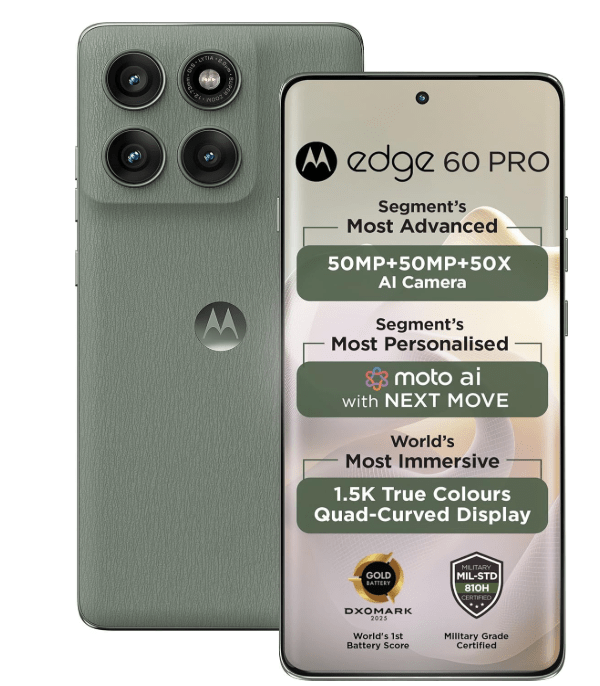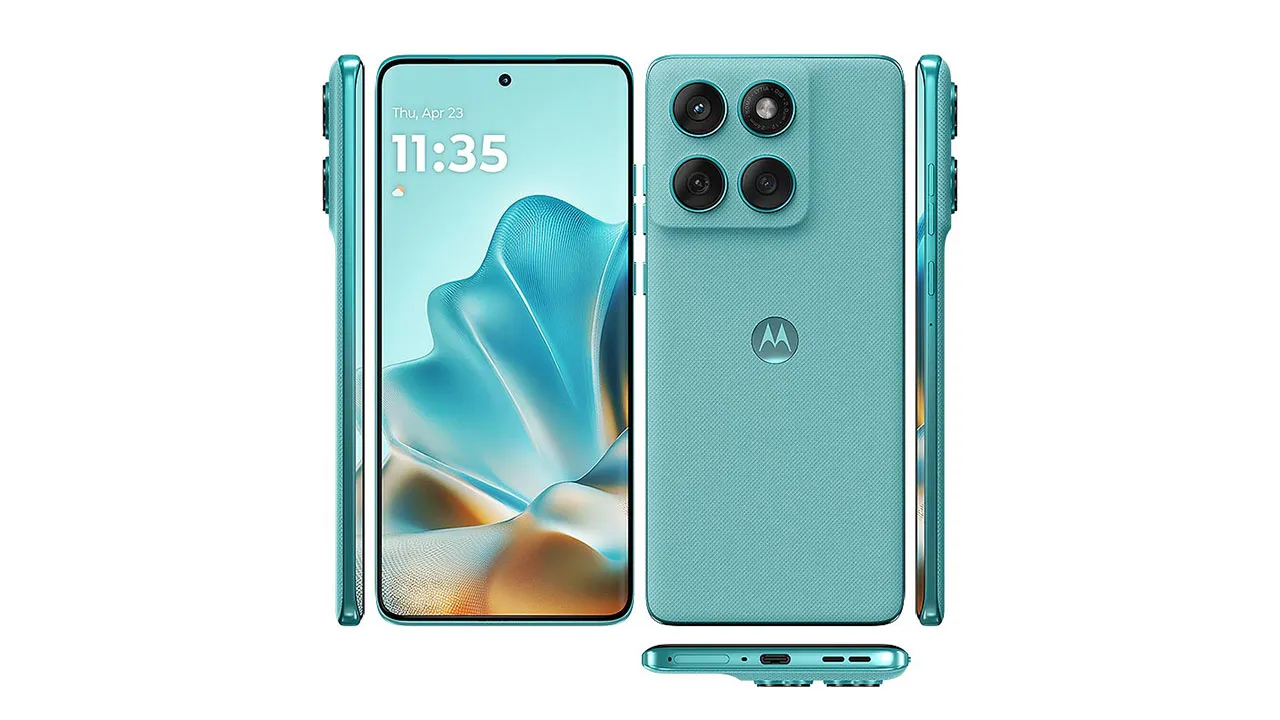
Motorola again, and another Edge phone is back to make a splash. But this time, it’s different. The Edge 60 Fusion isn’t just a pretty mid-range phone; it’s a bit like a handsome guy who goes to the gym and has a black belt! Let’s see how this phone, which has some fancy numbers on paper like a 4,500-nit display and an IP69 waterproof rating, fares in the real world. Motorola has always been known for its clean software and sleek designs, but it’s often overshadowed by the hardware power of competitors like Xiaomi or the dominance of the Samsung brand. Has Motorola finally managed to create a complete and flawless package with this phone, or is it still missing something?
Motorola Edge 60 Fusion Design Review
Motorola Edge 60 Fusion: Key Features
| Category | Specification / Feature |
|---|---|
| Design & Feel | Lightweight (~180g), thin (8mm), Vegan Leather back, Premium colors (e.g., Mykonos Blue) |
| Display | Quad-Curve edges (comfortable but vulnerable) |
| Durability | Gorilla Glass 7i, IP68/IP69, MIL-STD-810H |
| Market Strategy | Focus on physical experience and durability over top processor specs |
The first thing that catches your eye when you hold the Edge 60 Fusion is its lightweight and comfortable feel. Despite packing a massive battery and a whole host of durability standards, it weighs around 180 grams and is only 8 mm thick, which is truly an engineering feat. Motorola has used a silicone polymer with a Vegan Leather coating for the back cover and, in collaboration with the prestigious Pantone color institute, has chosen very stylish and special colors such as Mykonos Blue and Amazonite green. This combination gives you the feeling of a luxurious and expensive product, something that is rarely found in this price range.
The curved edges of the display and the back cover, called Quad-Curve, make the phone very comfortable to hold and have excellent ergonomics. Of course, this beauty is not without its problems; finding the right protective glass for curved displays has always been a challenge, and the edges of the screen are also more vulnerable when dropped.(Samsung S25 FE review)
But let’s get to where Motorola has everyone talking: the body’s resistance!
- Gorilla Glass 7i: The front of the phone is protected by this durable glass that is resistant to scratches and drops from heights of up to 1.2 meters.
- IP68/IP69 certification: This part of the story is very strange. IP68 means that the phone can survive in water up to 1.5 meters deep for up to 30 minutes. But IP69 means that it is also resistant to high-pressure hot water spray!. I have to say, this phone can survive a hot shower, a feature that even flagships costing tens of millions of dollars cannot claim!
- MIL-STD-810H military standard: This means that the phone has been tested in harsh environmental conditions such as very high and low temperatures (from minus 20 to 60 degrees Celsius), severe shock and vibration, and has come out victorious.
Motorola has shown that its strategy in the mid-range market is not just about competing on processor numbers. While competitors like Poco focus on the fastest processor, Motorola has spent its money on building a great physical experience, from the leather-like feel and unique colors to the durability that will keep you comfortable for years to come. This phone is built for someone who values looks, feel, and durability.(Methods of treating mobile phone addiction)
Motorola Edge 60 Fusion Display Review
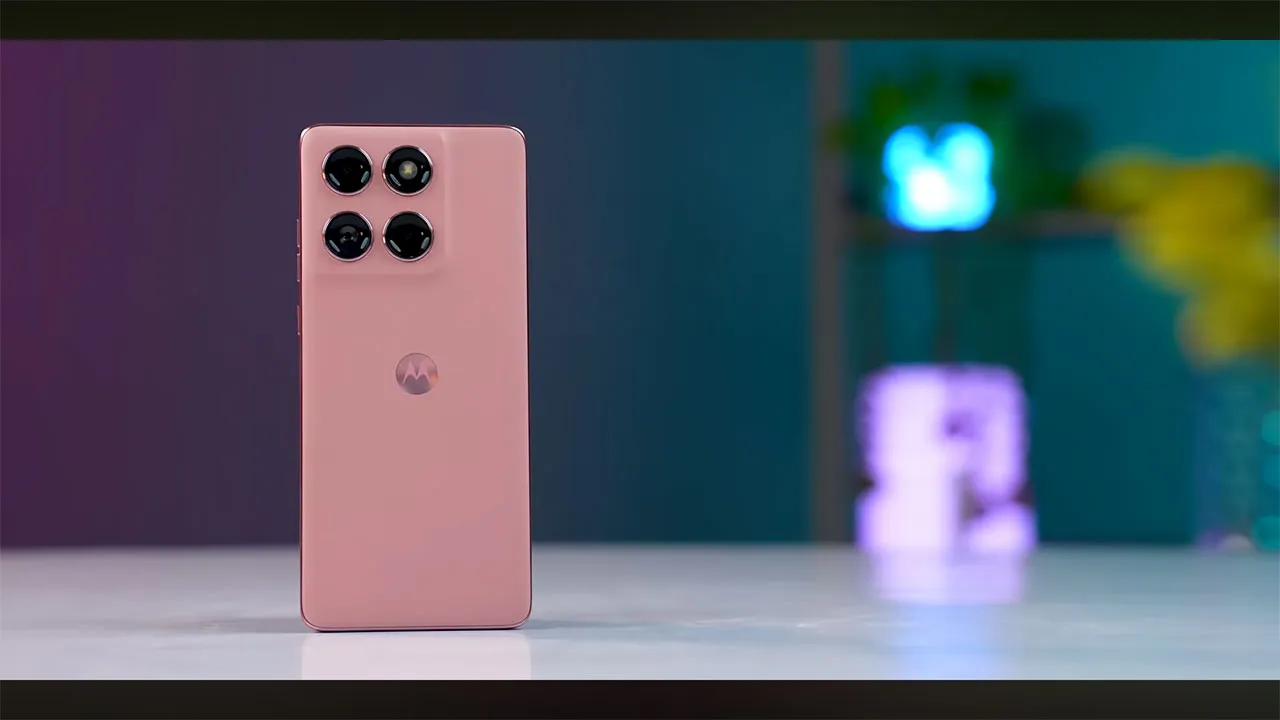
If the design is what you’re after, the Edge 60 Fusion’s display will make you fall in love with it. It’s a 6.67-inch pOLED panel that can display 1 billion colors (10-bit color depth) and covers 100 percent of the DCI-P3 color space. This means colors are incredibly vivid, accurate, and deep, and with incredible contrast, it’s ideal for watching movies and TV shows. The 1.5K resolution also shows more detail than typical FHD+ displays, and with a pixel density of 446ppi, everything is absolutely sharp and clear. Combine that with the 120Hz refresh rate for an incredibly smooth experience when browsing the web and using your phone.
But the real star of this section is the display’s dazzling 4,500 nits of brightness. Of course, you should know that this number is the peak or maximum brightness and is only activated for small parts of the screen when playing HDR content. The actual brightness that you achieve in auto mode (HBM) is between 1,370 and 1,500 nits. This number is also excellent in itself, and means that you can easily read messages on the street in the middle of the summer heat without straining your eyes. For comparison, rivals like the Samsung A56 or the Nothing Phone 3a have a brightness of around 1200 and 1300 nits respectively. This huge difference shows that Motorola has chosen the display as the main battleground to decisively defeat its competitors. Support for HDR10+ also ensures that you will see all the details in the darkest and brightest parts of the image when watching high-quality content on YouTube or Netflix.
Motorola Edge 60 Fusion Battery Review
Motorola has included a 5200 mAh battery for the global version of the phone, which has a larger capacity than most of its competitors. This battery, along with the optimized 4 nm MediaTek processor, has achieved very good charging performance. Various tests show that this phone can easily last a full day with heavy and mixed use, and even with normal use, you can count on it until the middle of the second day.
The charging speed is also excellent, thanks to the 68-watt TurboPower adapter. The phone takes about 44 minutes to fully charge from zero to one hundred. The more interesting thing is that, according to Motorola, with just 8 to 9 minutes of charging, you can store the energy needed for a full day. This means that when you wake up in the morning and see that the phone is not charged, by the time you have breakfast and get ready, the phone will be charged for the whole day!
Of course, you should keep two things in mind. First, some of the models that are released may not come with a charger, so be sure to ask the seller about this when buying. Second, this phone does not support wireless charging, which we would not have expected given its price.(1MORE iBFree in-Ear Earphones review)
Motorola Edge 60 Fusion Camera Review
Motorola has used a very good hardware combination for the Edge 60 Fusion camera, but its software is a bit sluggish.
Main Camera Review (50MP Sony LYT700C)
In daylight, this sensor, which also has optical image stabilization (OIS), takes excellent photos. Images are sharp, full of detail, and with a wide dynamic range. Thanks to the collaboration with Pantone, colors are very accurate and natural, although sometimes you may feel a little oversaturated. In low light, the camera performance is acceptable. The photos are bright enough and with controlled noise, but some details are lost and the images look a little soft. Overall, it performs well for a mid-range, but you shouldn’t expect miracles.
Ultrawide and Macro (13MP) Review
This lens is one of the best ultrawides in this price range, because unlike many competitors, it has autofocus. This feature has two big advantages; first, ultrawide photos are sharper and more detailed, and second, it can also act as a macro camera and take high-quality photos from a very close distance (3 centimeters).
Selfie Camera Review (32MP)
The selfie camera performs very well. The photos have high details and their quality is acceptable even in low light conditions. But the main trump card of the selfie camera is the ability to record 4K quality videos, a feature that is rarely found in mid-range phones.
Video Review
All three cameras (main, ultrawide, and selfie) can shoot 4K video at 30fps. The video quality of the main camera in daylight is very good, clean, and with natural colors, and the electronic image stabilization (gyro-EIS) does a good job of eliminating shake. The ultrawide videos are also good, but sometimes the colors look a little dull and you can have trouble focusing.
Main camera weakness
Despite all this good hardware, the camera app is disappointingly slow! This can ruin the photography experience, especially when you want to quickly take a picture of a passing scene. This shows that the camera hardware has a lot of potential, but the software is not yet fully optimized to exploit this potential. Of course, this is a problem that Motorola can fix with future software updates, but for now it will have to deal with.
Motorola Edge 60 Fusion Hardware Review
The beating heart of the Edge 60 Fusion is the MediaTek Dimensity 7400 processor, which is built with 4nm technology. This chip is quite powerful and smooth for everyday tasks such as web browsing, scrolling through Instagram and YouTube, and running multiple apps simultaneously. In benchmark tests, it scored around 3050 in the Geekbench multi-core section, which shows that it is slightly stronger than its predecessor, the Edge 50 Fusion. You can also count on this phone for gaming; it easily runs popular games with medium graphics settings. But if you are a professional gamer looking for the highest frame rate in heavy games like Genshin Impact, there are more powerful options on the market like the Poco X7 Pro.
The biggest hardware weakness of the phone is the type of internal memory used. Using UFS 2.2 internal memory was a decision to reduce costs. To put it simply, imagine you have a Ferrari (processor), but you want to drive it on a dirt road (UFS 2.2 memory). The car’s top speed is good, but acceleration and reaching that speed are slow. This means that installing apps, loading game levels, and moving large files are slower than competitors with UFS 3.1 or UFS 4.0 memory. Of course, this slowdown is not very noticeable in everyday use, but if you put the phone next to a competitor with faster memory, you will feel the difference.
Unlike many new phones, the Edge 60 Fusion supports microSD memory cards up to 1TB in capacity. This is a huge advantage for those who take a lot of photos and videos or like to always have their movie and music archive with them.
Motorola Edge 60 Fusion Software Review
One of the main reasons why many people love Motorola phones is the software. The Edge 60 Fusion ships with Android 15, giving you a very close-to-stock Android experience, light, smooth, and free of bloatware and annoying ads. Motorola has also added a number of its own useful and exclusive features, such as Moto Actions (gesture controls like shaking the phone twice to turn on the flashlight) to this pure Android that really make it work. This phone is the first Motorola product to be equipped with Moto AI, and offers features like text summarization or creating photos with text commands, although these features are still in their infancy and have room for improvement.
But the most important part of the software is the golden promise of support. Motorola has promised to release 3 years of major Android updates (up to Android 18) and 4 years of security updates for this phone. This means your phone will remain up-to-date and secure for years, but it still doesn’t reach the excellent support of Samsung phones.
Edge 60 Fusion Speaker Review
This phone is equipped with stereo speakers that are loud and can easily fill a small room. The sound quality is also very good thanks to Dolby Atmos support; the sound is warm, deep, and well-defined. When watching movies or playing games, you can really feel the sound coming from both sides and have an immersive experience. Of course, the volume is a little low before 80%, but overall the speaker performance is quite satisfactory.
Is the Motorola Edge 60 Fusion worth buying?
First, let’s compare it to its predecessor. The Edge 60 Fusion has made a big leap in almost all key areas; its display is noticeably brighter (4500 nits vs. 1600 nits), its processor is slightly more powerful, its battery is larger (5200 vs. 5000 mAh), and its body is at the level of a true flagship with IP69 and military-grade certifications. Plus, it has added support for a memory card, which the previous generation didn’t have. So there’s no doubt that the upgrades are quite meaningful and important, and if you’re in doubt between these two models, the Edge 60 Fusion is definitely worth the extra cost.
But the main competition is with similarly priced phones on the market. Considering the price of the Edge 60 Fusion, two of its most important competitors are the Samsung A56 and the Nothing Phone 3a.
Well, we’ve reached the end of the line. The Motorola Edge 60 Fusion is a phone full of contradictions. On the one hand, it charms with a display and body resistance on par with flagships, on the other hand, it’s a little annoying with its UFS 2.2 memory and slow camera app.
Is it worth buying? Our answer is a resounding yes, but with one condition. If you’re someone who wants a phone for watching content, browsing the web, and taking everyday photos, and the durability and beauty of the phone are more important to you than playing Call of Duty at 120 frames, the Edge 60 Fusion is one of the best, if not the best, choices in this price range. IP69 resistance and military standards mean that this phone is not a half-hearted companion and will stay by your side for years. Its giant battery and fast charger also give you peace of mind when it comes to charging. Overall, Motorola has created a very balanced and attractive package with the Edge 60 Fusion, which, with a focus on durability and display, can be an attractive option alongside popular products from Samsung and Xiaomi brands, and is considered a serious competitor for everyone.