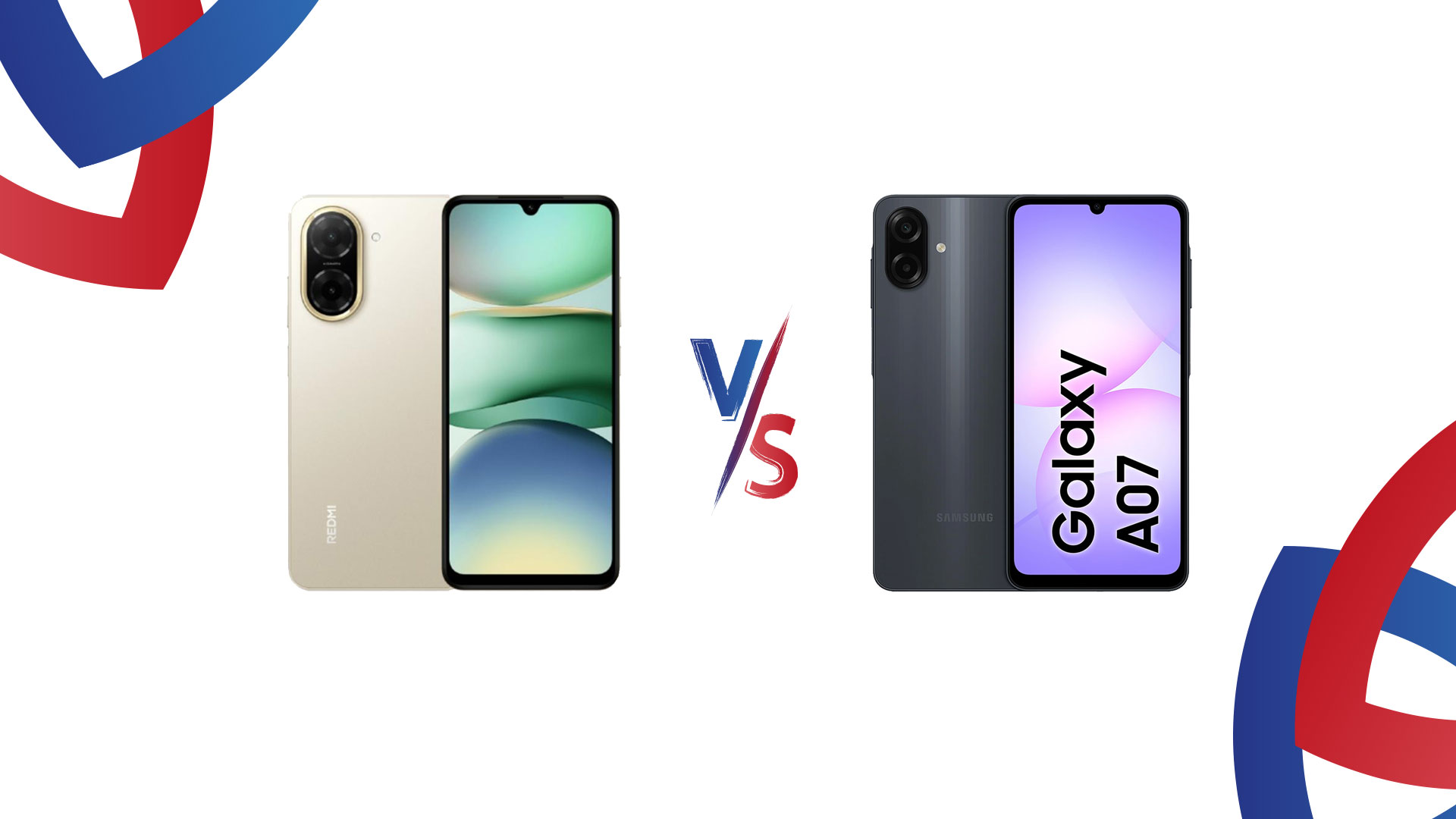
In this mobile market, buying a phone is no longer just a simple purchase; it has become a strategic and vital investment! Finding a phone that will both get you started and keep you comfortable for years to come. Today, we want to pit two of the market’s economic gladiators against each other: Samsung Galaxy A07 vs. Xiaomi Redmi A5.
You might be thinking: What do these cheap phones have that we should be looking at? But you’d be wrong! In this price range, the main competition is elimination. Companies have to decide what to eliminate to keep the price low: a good screen? A powerful processor? Or build quality?
The story goes that Samsung with the Galaxy A07 and Xiaomi with the Redmi A5 adopted two completely different philosophies. Samsung has bet all its chips on stability and software, but Xiaomi has gone for flashy looks and big numbers that will impress at first glance. In our comparison of the Samsung A07 and Xiaomi Redmi A5, we are not just going to say which camera has more megapixels or which one has a higher frame rate; we want to spill the beans on these two phones. So, tighten your belts for an interesting and controversial comparison between these two budget phones on the market.
Design comparison of the Samsung A07 and Xiaomi Redmi A5
What is the first thing that attracts us when buying a phone? Of course, the look and feel of it in the hand. Samsung unified its design language in 2025. This means that now, if you look at the back of a flagship S25 phone and a budget A07 phone from a distance of 2 meters, you may not notice the difference at first glance (of course, if we take the body material into account!).
Samsung Galaxy A07 Body
- Design Language: The A07 uses the same famous and minimalist vertical camera layout, with no camera island. The lenses are very stylish and protrude directly from the body, which makes it look clean and modern.
Handiness: One of the strange strengths of this phone is its thickness. At 7.6 mm thick, this phone is one of the thinnest on the market in this price range. This low thickness makes the phone sit very comfortably in the hand and gives the feeling of a modern and more expensive product. - Body Material: Well, it is clear that the back cover and frame are plastic. But Samsung has used a vertical striped texture that is both beautiful and makes the phone less slippery and less likely to show fingerprints. The power and volume buttons are also on the right and are located on a slight protrusion called Key Island, which is considered Samsung’s new design signature in the A series.
Xiaomi Redmi A5 Body
Xiaomi, however, has gone the exact opposite direction. They want their phones to look expensive and fancy.
- Camera module: The Redmi A5 has a big circular camera module up in the middle of the back, trying to emulate Xiaomi’s flagships (like the Ultra series). The design is quite tasteful; some love its grandeur, others say it’s too busy and bulky.
- Dimensions and weight: This phone is officially bigger and heavier. At 171.7mm tall and 8.3mm thick, it feels like a large phablet. Its weight of 193g is also noticeably heavier than the A07.
- Body material: Xiaomi has used a material that looks like glass on the back of the phone (they call it Glasstic). This makes the phone look very shiny and sleek at first glance, but what’s the other side of the coin? It attracts fingerprints and smudges! If you’re a stickler, you should always have a tissue in your pocket or put it in the case first.
Design Conclusion:
D Feel in the Hand: The Samsung A07 has much better ergonomics for long-term use due to its thinner thickness and flat edges. The Redmi A5 is a bit more difficult to use with one hand due to its wider width (77.8 mm vs. 77.4 mm for the Samsung).
- Water Resistance: The Samsung A07 is IP54 certified; meaning it can withstand a little rain or splashing. The Redmi A5 doesn’t have an official certification in this price range, or it’s limited to a water-repellent nano-coating that’s not very reliable.
- Summary: If you’re looking for class, simplicity, and ease of use, go for the Samsung A07. If you’re looking for attention, a sleek look, and a larger screen, the Redmi A5 is for you.
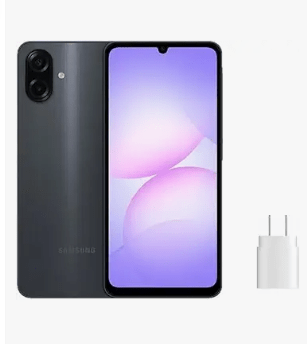
Samsung Galaxy A07 4G AI
XIAOMI Redmi A5 4G LTE

Samsung Galaxy A07 vs Xiaomi Redmi A5
| Specification | Galaxy A07 | Redmi A5 4G |
|---|---|---|
| Release | ||
| Announced | 2025, August 25 | 2025, March 21 |
| Status | Available (Aug 25, 2025) | Available (Mar 21, 2025) |
| Body | ||
| Dimensions | 164.4 x 77.4 x 7.6 mm | 171.7 x 77.8 x 8.3 mm |
| Weight | 184 g | 193 g |
| Build | Glass front, plastic back & frame | Plastic build |
| Protection | IP54 dust & splash resistant | Dust & splash resistant |
| Colors | Gray, Light Violet, Dark Green | Ocean Blue, Lake Green, Sandy Gold, Midnight Black |
| Display | ||
| Type | PLS LCD, 90Hz | IPS LCD, 120Hz |
| Size | 6.7 inches | 6.88 inches |
| Resolution | 720 x 1600 (~262 ppi) | 720 x 1640 (~260 ppi) |
| Battery | ||
| Capacity | 5000 mAh | 5200 mAh |
| Charging | 25W wired | 15W wired |
| Main Camera | ||
| Setup | 50 MP + 2 MP (Dual) | 32 MP (Single) |
| Video | 1080p@30/60fps | 1080p@30fps |
| Selfie Camera | ||
| Camera | 8 MP | 8 MP |
| Video | 1080p@30fps | 1080p@30fps |
| Performance | ||
| Chipset | Helio G99 (6nm) | Unisoc T7250 (12nm) |
| CPU | Octa-core (2×2.2GHz A76) | Octa-core (2×1.8GHz A75) |
| GPU | Mali-G57 MC2 | Mali-G57 MP1 |
| Memory | eMMC 5.1 + microSD | eMMC 5.1 + microSD |
| Software | ||
| OS | Android 15, One UI 7 (6 upgrades) | Android 15 Go, HyperOS (2 upgrades) |
| Connectivity | ||
| Network | GSM / HSPA / LTE | GSM / HSPA / LTE |
| Wi‑Fi | Wi‑Fi ac, dual‑band | Wi‑Fi ac, dual‑band |
| Bluetooth | 5.3 | 5.2 |
| USB | USB‑C 2.0 | USB‑C 2.0 |
| 3.5mm Jack | Yes | Yes |
| Price | ||
| Approx. Price | ~70 EUR | $104 |
Samsung A07 vs Xiaomi Redmi A5 Display Comparison
This is exactly where the numbers and figures fight on paper, but let’s see what’s going on behind the scenes. Xiaomi has really dusted the paper.
Xiaomi Redmi A5:
- Size and technology: A giant 6.88-inch IPS LCD panel. It’s a must-watch for movies and TV shows!
- Refresh rate: An impressive 120 Hz! In this price range, 120 Hz is really rare. But let’s be technical and honest. Cheap LCD panels usually have a high pixel response time. What does this mean? That is, even if the screen refreshes 120 times per second, the pixels may not be able to change color at that speed and you may see ghosting or shadowing when scrolling quickly. However, the smoothness of the menu movement is quite noticeable compared to 60 Hz.
- Brightness: 450 nits of brightness, which can reach 600 nits. It’s great for home use, but in direct sunlight you’ll probably have to shade your phone to read your messages.
Samsung Galaxy A07:
Samsung takes a conservative but higher-quality approach here.
- Size and technology: 6.7-inch PLS LCD panel. PLS (Plane to Line Switching) technology is essentially Samsung’s own improved version of IPS. Overall, Samsung’s PLS panels have a slightly better contrast and wider viewing angles than the typical Chinese IPS.
- Refresh rate: Samsung has settled for 90Hz. You might say 120 is better than 90, but stability is more important, folks! Samsung’s processor (which we’ll get to later) is capable of rendering a steady 90fps, but Redmi’s processor can’t quite fill 120fps in most cases, and frame rate fluctuations can be annoying.
- Resolution and color: Both phones have HD+ resolution (around 720 x 1600 pixels). At 6.88 inches, the Redmi has a pixel density of about 260ppi, while the Samsung has about 262ppi. There’s not much difference in practice, and the pixelation of the text is only noticeable if you hold the phone up to your eyes. Samsung usually has better color calibration; the colors on the A07 are a bit more vibrant and saturated, which is more appealing to most users. The Redmi A5 shows colors a bit cooler (blueish), which can be tweaked in the settings.

Comparison of Samsung A07 and Xiaomi Redmi A5 battery performance
Capacity and charging:
D Redmi A5: 5200 mAh battery. An extra 200 mAh means about 30 to 40 minutes more work in ideal conditions. But remember that this phone’s 12-nanometer processor consumes more power. So, the charging time is practically the same as the Samsung, and the pair will last about 1.5 days of combined use.
T Samsung A07: 5000 mAh battery. Thanks to its energy-efficient 6nm processor, it has excellent battery management and can easily last up to 2 days if you don’t use it heavily.
Charging speed and adapter (big choice):
Here’s what you need to choose:
- Redmi A5: Supports 15W charging and comes with a charger in the box. Having a charger is great, but charging a 5200mAh battery at 15W is a pain in the ass! It takes about 2.5 to 3 hours to fully charge.
- Samsung A07: Supports 25W charging but doesn’t come with a charger in the box (Samsung’s usual policy). Your phone will charge in about 1 hour and 20 minutes, which is almost half the time.
Question: How much is your time worth? If you can afford the charger, Samsung’s 25W speed will really improve your quality of life. Waiting 3 hours to charge your phone in 2025 is really annoying.(Introducing the Samsung Galaxy Z TriFold)
Samsung A07 vs Redmi A5 Camera Comparison
There are big numbers on the boxes, but what about the real quality?
Main camera:
- Samsung A07: 50MP main sensor + 2MP depth sensor. Samsung is a master of image processing (ISP). Samsung’s HDR algorithms work well even on budget phones, keeping shadows bright and skies blue. The f/1.8 aperture also lets in good light, which helps you at night.
- Redmi A5: This phone has a 32MP camera. Photos are good in daylight, but as soon as the light gets low, noise attacks! The Unisoc image processor is not as good as MediaTek’s, and photos sometimes look pale or overly sharp and artificial.
Selfie and video recording: - Selfie: Both are 8MP. Samsung’s selfies are more natural and capture skin tones more accurately. Xiaomi, however, has a Beauty Mode enabled by default that smooths and brightens the skin (it has its own fans).
- Video recording: Both are limited to 1080p@30fps. Optical Image Stabilization (OIS) is a joke at this price and you have to rely on your steady hand. Samsung’s microphones record clearer sound and eliminate wind noise better.
Hardware Comparison of Samsung A07 and Xiaomi Redmi A5
This is the most important part of the comparison. Where the difference between a smooth phone and a nerve-wracking phone becomes clear. Let’s dissect the chipsets.
The beating heart of the A07 is the MediaTek Helio G99 chip.
- Lithography: This chip is made with TSMC’s 6nm technology. A lower number in nanometers means smaller transistors, lower power consumption and less heat generation. 6nm is great for a budget phone.
- Cores: It has 2 powerful Cortex-A76 cores with a frequency of 2.2 GHz and 6 low-power cores. The A76 cores have a more modern architecture and perform very well in heavy tasks.
- Graphics: Mali-G57 MP2 graphics processor (dual core). This means it has enough graphics power to run games at medium settings.
The beating heart of the Redmi A5 is the Unisoc T7250 chip.
- Lithography: This chip is 12nm! In 2025, using 12nm lithography is like using an arrow motor on a Peugeot body. This means more battery consumption and more heat than the competition.
- Cores: It has 2 Cortex-A75 cores (one generation older than Samsung) and a lower frequency.
- Graphics: Mali-G57 MP1 GPU (single-core). Having only one graphics core is the Achilles heel of this phone in games.
In the AnTuTu benchmark, Samsung scores about 420,000 points and Xiaomi scores about 270,000. That means Samsung is about 55% stronger!
When working with the Galaxy A07, opening WhatsApp, scrolling through Instagram, and switching to the camera are done with a slight pause. But on the Redmi A5, especially if you have several apps open, you may experience momentary lags. That 120Hz display on the Redmi becomes the Achilles heel here; Because the processor does not have enough power to render the interface at 120 frames and you constantly see frame drops that make you feel sluggish. In Call of Duty, Samsung also offers a real gaming experience, but it fails… Let’s move on!
Comparison of the user interface of Samsung A07 and Xiaomi Redmi A5
In the modern world, hardware is nothing without software! Samsung has exploded a bombshell in the A07: 6 years of software and security updates!
- Operating system: Android 15 with the One UI 8 user interface.
- User experience: One UI is the most mature Android shell. Features such as Modes and Routines (for automation), Secure Folder, and lock screen customizations are at your fingertips.
- Future-proofing: By buying the A07, you get up to Android 21! This means that your phone will remain updated until 2031. This also increases the resale value of the phone.
Xiaomi has used Android 15 Go Edition to cover up the processor weakness. - What is Go Edition? A lighter version of Android that has some heavy features (like complex animations) removed. Google apps are also usually Go editions.
- Limitations: You don’t get the full Xiaomi HyperOS experience. Many of the visually appealing features are removed.
- Updates: Usually, the lower-end Redmi series gets a major update for at least 2 years. So don’t expect much in terms of support.
Comparison of Samsung A07 and Xiaomi Redmi A5 speakers
Both have single speakers (mono). Don’t expect stereo at this price. Samsung’s sound is less sharp at high volumes and has a better bass. Redmi’s sound is loud, but at maximum volume its quality drops and it becomes shrill.(Xiaomi Poco X7 Pro long-term review)
Which one is worth buying more between A07 and Redmi A5?
So we’ve reached the last stop. Let’s compare two by four and see what’s what. Absolute winner for quality and performance; Samsung A07
If your budget allows it, don’t hesitate for a moment. The A07 is a more complete phone. A much more powerful processor (Helio G99), a better display, smooth and complete software, a real 50MP camera and most importantly 6 years of updates make this phone a safe investment. By buying this phone, you are buying a mid-range phone dressed in cheap clothes. You will see the cost of the charger once, but you will enjoy better charging speed and smooth performance for years.
Limited budget winner; Xiaomi Redmi A5
If you are really on a budget and every dollar counts, the Redmi A5 is not a bad option. You get a large 120Hz display (albeit with mediocre performance), a modern look and a massive battery, and you don’t need to buy a charger. This phone is suitable for students, elderly people who don’t use it heavily, or as a second phone. But don’t expect heavy gaming or fast app opening speeds.