
Today we are going to talk about a product that Samsung quietly introduced on December 2, 2025 without any background and that until a few years ago we only saw in science fiction movies like Westworld. A product that has not only blurred the line between smartphone, tablet and pocket computer, but also officially removed and crushed it! Yes, we are talking about the Samsung Galaxy Z TriFold; Samsung’s first attempt to enter the world of three-piece phones or Trifold.
After Huawei made that strange noise with the Mate XT Ultimate and stole the title of the first, we were all waiting to see what answer Samsung, who considers itself the godfather of foldable phones, had up its sleeve. Will we just see a simple copycat or is Samsung going to set new standards with its own Korean engineering? If you want to know what this $ 2,500 giant has, stay with us until the end of this article.
Thickness is no joke!
The first thing that really stands out about any foldable phone, especially a tri-fold one, is the design and engineering. Let’s be honest, making a phone that folds once is a disaster, but imagine folding it twice and expecting it to not weigh like a brick in your pocket! Samsung has walked that razor’s edge with the Galaxy Z Trifold. Samsung claims that the phone is just 3.9mm thick at its thinnest when unfolded. Let’s take a look at that number. 3.9mm is about half the thickness of many regular phones you can buy right now. Of course, there are a few caveats to this number; this is without taking into account the camera bump and the built-in protective layers. To be more precise, the thickness of the different panels varies:
- Side panel (where the SIM card is): 3.9 mm
- Middle panel: 4.2 mm
- Side panel (where the buttons are): 4 mm
These small differences in thickness may not be noticeable, but they show how hard Samsung engineers struggled to fit components into this tight space. When you close the phone (Folded mode), the total thickness reaches about 12.9 mm. This means a thickness that is almost the same as the Galaxy Z Fold 5 or 6, which is an amazing engineering feat considering that there are three layers on top of each other. For comparison, the Huawei Mate XT is 12.8 mm when closed, so Samsung has been able to keep up with the competition in terms of thickness, even with the folding mechanism that inherently takes up more space.
Hinge Mechanism: Titanium’s Double Dance
The mechanical heart of this phone is a new hinge system that Samsung calls the Armor FlexHinge. Unlike regular foldable phones that have a single hinge, here we have two hinges that have to work together. To make sure that these hinges don’t give out under the pressure of constant opening and closing, Samsung used titanium in their construction. Titanium is both lightweight and highly resistant to metal fatigue.
A very important point in Samsung’s design is the use of an inward-folding mechanism for both hinges. This is the exact opposite of Huawei’s approach with the Mate XT, which folds one inward and one outward (Z-shape). Samsung decided to be conservative and fold both wings of the phone inward so that the main 10-inch display, when the phone is closed, is completely safe and sandwiched between the layers of the body. This means that keys and coins can’t scratch that expensive display when it’s in your pocket.
One of the coolest, and perhaps most bizarre, design features of this phone is the Auto-Alarm system for misfolding. See, because we have two hinges and the panels have to close in a specific order (for example, the left panel first, then the right panel), if you try to force the phone to fold the other way or if you don’t follow the order, the internal sensors will detect it.
The phone will start vibrating and display a message on the screen warning you, “Don’t do it! You’re making a mistake!” This shows how complex and sensitive the internal mechanism is and how worried Samsung is that users will get excited and destroy the $2,500 phone on the first day. This feature may seem funny, but it shows the attention to detail in the user interface (UX) design of a new hardware product.(The best flagship phones; which ones are worth your money?)
Materials and build quality: Luxurious and industrial
In the material department, Samsung has not skimped. The frame around the phone is made of Advanced Armor Aluminum, which is very resistant to impacts and scratches. The back panel is also made of Ceramic-Glass Fiber Reinforced Polymer. What does this long name mean? It means a combination of ceramic, glass, and polymer fiber that gives the luxurious feel of glass, the lightness of plastic, and the strength of ceramic.
The phone weighs 309 grams. You might say, wow, how heavy! But let’s be fair. You’re practically carrying a 10-inch tablet and a phone at the same time. The iPhone 14 Pro Max weighs 240 grams with those dimensions. So 309 grams is a reasonable number for this amount of technology and battery, although it definitely feels heavy in your pants pocket.
The color scheme is currently limited to a special color called Crafted Black. This black has a special texture, similar to carbon fiber, which gives the phone an industrial and very professional feel. Samsung wants to say with this color that this phone is not a toy, but a serious tool for business and heavy work.
Display; an ocean of pixels in your pocket
Now, let’s get to the main reason for the existence of this phone: the screens. Here we are faced with two completely different visual experiences, both of which Samsung has tried to keep at the highest level of quality.
Cover Screen: A window to the outside world
When the phone is closed, you are faced with a 6.5-inch screen that plays the role of a regular phone. But this regularity is only in size, not in quality.
- Panel: Dynamic AMOLED 2X
- Resolution: 2520 x 1080 pixels
- Brightness: Peak brightness 2600 nits
- Refresh rate: 120 Hz adaptive (LTPO)
- Protection: Gorilla Glass Ceramic 2
2600 nits of brightness is excellent for a cover screen. This means that you can work comfortably even in the middle of the desert at noon. The 21:9 aspect ratio also makes the phone comfortable to hold and easy to use with one hand, even though it’s a bit tall. The display is practically the same as you’d expect from an S-series flagship, so you don’t need to open the phone for everyday tasks like calling, texting, and checking Instagram.
Main Screen: Your own IMAX theater
But here’s the real magic! When you open the phone in two steps, you’re greeted by a gigantic 10-inch display.
- Panel: Dynamic AMOLED 2X foldable
- Resolution: 2160 x 1584 pixels
- Pixel density: 269 ppi
- Brightness: Peak brightness 1600 nits
- Refresh rate: 1-120 Hz adaptive
You might be wondering why the brightness of the inner screen (1600 nits) is lower than the outer screen? The reason is power and heat management. Turning on a 10-inch panel at 2600 nits will both drain your battery and melt your phone in half an hour! Still, 1600 nits is a very good number for a foldable screen, and it’s quite satisfying. Vision Booster technology also helps optimize contrast and colors in bright environments.
Crease Challenge: Two lines on the face of the moon!
In regular foldable phones, it’s always been about that middle line. Now here we have two crease lines! Because we have two hinges. Samsung claims to have minimized the amount of creases by using a new hinge structure and screen protection layers. Initial tests show that these lines are almost invisible when you look at the content from the front. But the reality of physics is that if you shine light at an angle or swipe your finger across the screen, you will definitely feel those two valleys. This is the price of having a tablet in your pocket, and technology has not been able to completely eliminate it yet.
The aspect ratio of the unfolded screen is approximately 4:3 (a little wider). This ratio is great for web browsing, working with documents, and multitasking, but for watching movies (which are usually 16:9 or 21:9), you’ll end up with thick black bars at the top and bottom of the image. Of course, given the 10-inch size, you still get a large image even with the black bars, but it doesn’t fill the entire screen.
Battery and Charging; Triple-Slot Atomic Powerhouse
One of the main concerns with foldable phones is battery life. A bigger screen means more power. Samsung has come up with an interesting solution to this problem. The Galaxy Z Trifold has a three-cell battery system with a total capacity of 5,600 mAh.
What does this mean? It means that there is a thin and wide battery in each of the three panels of the phone. This has two advantages:
- High capacity: 5,600 mAh is a very good number for a foldable phone (the Z Fold 6 had a 4,400 battery!).
- Weight distribution: Because the batteries are spread out, the phone feels balanced in the hand and one side is not heavier than the other.
Samsung claims that with this battery you can watch up to 17 hours of continuous video. Given the optimized Snapdragon 8 Elite processor and LTPO displays that can lower the refresh rate, it is expected that in normal use (a combination of closed and open screens), this phone will easily last a full day and even a little more. Of course, if you keep the 10-inch screen on and turn the brightness all the way down, the consumption will naturally be higher.
The good news is that this phone supports 45W wired charging and 15W wireless charging. 45W may seem low compared to the 100W chargers from Chinese manufacturers, but it is standard for Samsung.
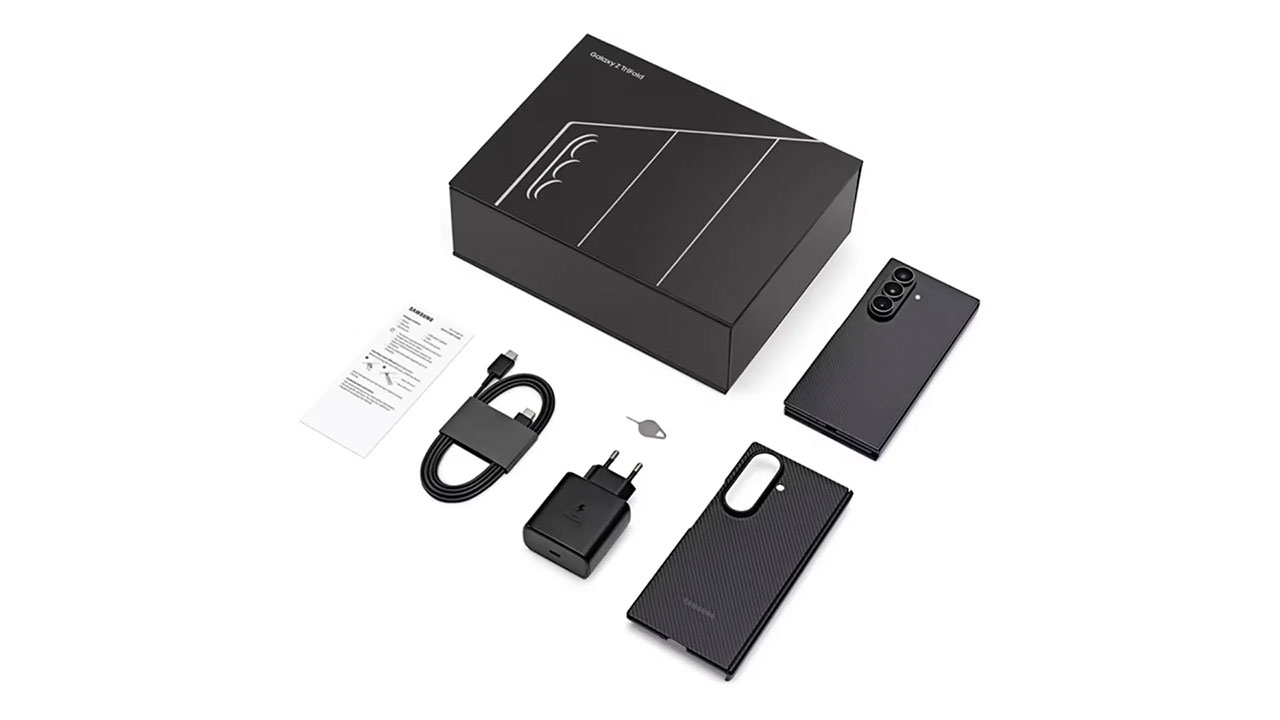
But the better and more strange news: a 45W charger is included in the box!
Yes, you read that right. Samsung, which had been eliminating the charger for years, has been generous with this $3,000 phone and has included a charger, cable, and even a protective case in the box. Apparently, Samsung also understood that someone who pays that much money has to buy a charger separately!
Camera; 200 megapixels on a foldable phone?!
Usually, foldable phones have always been a step behind the flagship S series in the camera department. The reason was the lack of space for large sensors. But Samsung has broken tradition in the Z Trifold and installed a flagship-level camera module.
Camera specifications
Using a 200 megapixel sensor in a foldable phone is a big move. This means you can take photos with terrible detail. Samsung is probably using the same processing algorithms of the S25 Ultra, which, by combining 16 pixels in 1 pixel (Pixel Binning), delivers 12.5 megapixel photos with excellent light absorption at night.
Why not 10x zoom?
You may ask, so where is the 100x spatial zoom? Well, we have to get down to physics here. Periscope cameras (which provide 5x or 10x optical zoom) need thickness because the lenses are arranged vertically. When the phone is 3.9mm thick, it’s impossible to fit a thick periscope module in there, unless they make a really ugly and bulky protrusion on the back. Samsung has opted to keep the design slim and settle for a 3x zoom. Of course, with a 200MP sensor, you can get high-quality digital zoom (Lossless Crop), which somewhat fills the gap left by the optical zoom.
One of the advantages of foldable phones is that you can open the phone and use the main 200MP cameras to take selfies, while seeing yourself on the cover screen (now on the back of the phone). This means the highest quality selfies possible, with realistic portraits and accurate skin details. Bloggers will love this feature!
Hardware and Performance; The Dragon That Has Been Tamed
Samsung Z Trifold – Power & Software Mastery Flow
Samsung didn’t take any risks for the mastermind of this monster and went with the best option on the market. Snapdragon 8 Elite for Galaxy. This chipset is a beefed-up version of Qualcomm’s proprietary chip for Samsung, which was also used in the S25 Ultra.
The Snapdragon 8 Elite is a 3nm chipset that packs a punch. Qualcomm’s new Oryon cores in this chipset have dramatically improved single-core and multi-core performance. For a phone that’s going to run three apps at once, that’s vital power.
The new Adreno is also making a splash in the graphics department. Games like Genshin Impact or Call of Duty Warzone run at their highest graphics on this 10-inch screen, providing an experience close to handheld consoles.
Samsung didn’t skimp on this model. 16GB of RAM is standard on all models. This amount of RAM is absolutely essential to manage all the pixels that need to be rendered and the apps that are open at the same time.
You also have two options in the internal memory section:
- 512 GB
- 1 TB
There is no news about the 256 GB model, which is quite logical. The person who buys this phone definitely has a lot of data and does not want to worry about the memory filling up. The memory type is UFS 4.0 (or maybe the newer version 4.1 according to some rumors), which has a space-like data transfer speed.
Cooling system
One of the biggest engineering challenges in this phone is heat dissipation. When the body is 3.9 mm thick, where do you want to put the heat pipes and the vapor chamber? Samsung has had to place the chipset in one of the side panels (probably the panel where the cameras are) and use an advanced heat dissipation system to spread the heat across the surface of the body. However, it is expected that during long-term heavy processing, that part of the body will get hot and the system will lower the screen brightness or processor frequency to prevent damage. This is physics and there’s nothing you can do about it, unless they put a fan in, which is impossible at this thickness.
Software and UI; One UI dances on three stages
Powerful hardware without smart software is just a piece of broken iron. Samsung, the king of foldable phone software, has left no stone unturned here either. The Galaxy Z Fold 2 comes with Android 16 and One UI 8.
Revolutionary multitasking: Split Trio
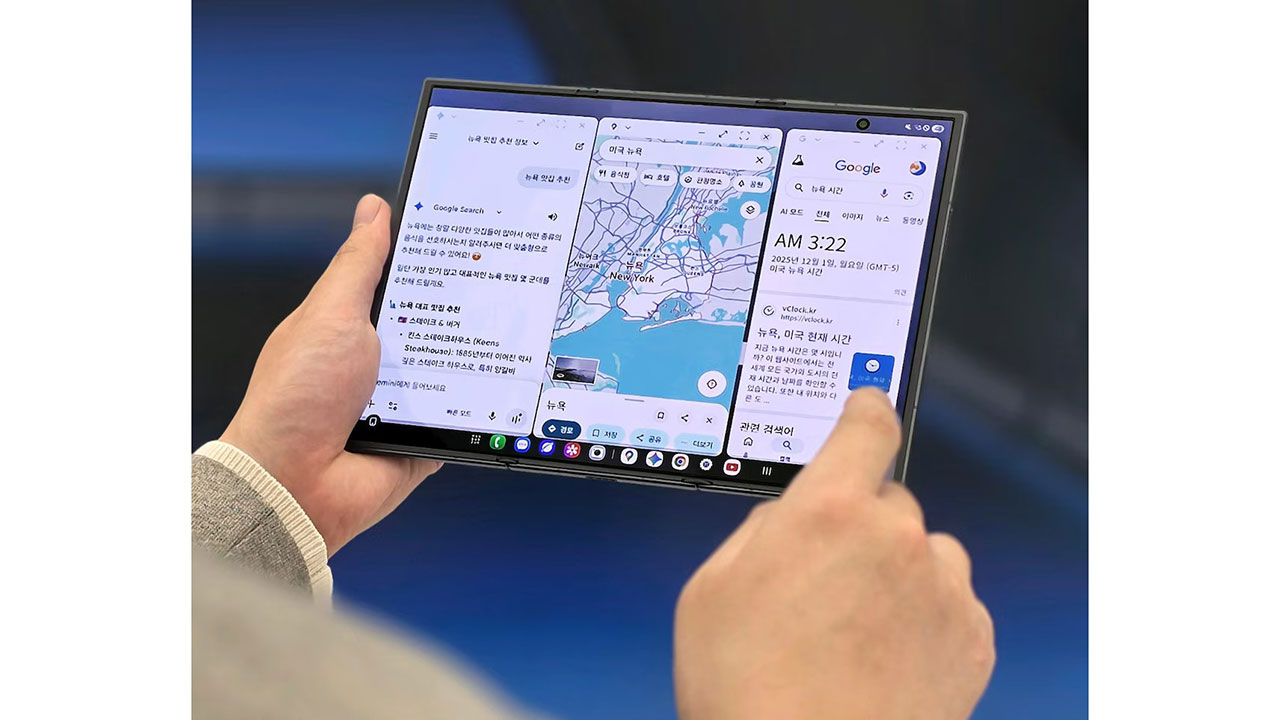
The most important software feature of this phone is a new feature called Split Trio. Previously, we could split the screen in half on Z Fold phones, but here we can run three full-fledged applications side by side in a column.
Imagine:
- Left column: WhatsApp for chatting.
- Middle column: Chrome for browsing the web.
- Right column: YouTube for watching videos. This level of multitasking on mobile is unprecedented. Samsung says that you can customize the layout of these windows and even arrange them horizontally or vertically. Also, the App Pairs feature that we had before is now more advanced and you can create groups of three apps and open all three together with a single touch.
Samsung DeX without the need for a monitor!
This is one of those features that leaves people speechless. The Galaxy Z Trifold is the first Samsung phone to have Standalone DeX. What does it mean? It means you don’t have to connect the phone to a monitor with a cable to get a desktop interface. The 10-inch screen of the phone itself becomes a desktop environment! You can connect a Bluetooth mouse and keyboard to it and practically have a small laptop. In this mode, the Taskbar looks like Windows, the windows float and you can have up to 4 different Workspaces, each with 5 apps open. This is a godsend for those who are constantly traveling and want to do office work.
Galaxy AI and Gemini Live
Of course, all the AI features we saw in the S25 series and Z Fold 6 (such as live translation, text summarization, photo editing) are here too. But a new feature is deep integration with Google’s Gemini Live.
You can have a live and continuous conversation with the AI. For example, you are watching a video on YouTube and at the same time ask Gemini where is this place in the video? And it will answer you by analyzing the image, without having to pause the video or take a screenshot.
Speakers and sound; Mobile cinema
Information about the audio system of this phone shows that we are dealing with stereo speakers. Given the more body space and the number of panels, it is expected that the volume and sound separation (Sound Separation) will be better than the regular Z Fold. For watching movies on a 10-inch screen, high-quality sound is half the fun.
Big absence; S Pen
🚨 Major Dealbreaker
A massive 10-inch display…
But no S Pen support at all.
We come to one of the biggest drawbacks of this phone. Although we have a 10-inch screen that is great for drawing, sketching, and note-taking, the Galaxy Z TriFold does not support the S Pen. Yes, it does not have a pen slot, and it does not work even if you slide the S25 Ultra or the Fold series pens on it.
Why?
The main reason is technical and engineering. In order for the pen to work on the screen, an additional layer called the digitizer is needed under the screen. Adding this layer to a screen that is supposed to be folded twice and needs to be so thin increases the thickness and complexity. Also, digitizers usually have limited flexibility and are very difficult to fold at two points with different radii.
Samsung has chosen the former between being thin and having a pen. This is a big disadvantage for those who are used to drawing with their tablets and may make them not go for this phone.
Price and release date; Are you ready?
Now we come to the painful part. Price! The phone is set to launch first in South Korea on December 12, 2025 (in just a few days). The base price in Korea is announced to be around 3,590,400 won. If we take out a calculator and convert, it will be around 2,450 to 2,500 US dollars.
Global launch time:
Samsung said that after Korea, the phone will reach the markets of China, Taiwan, Singapore, the UAE and finally the US and Europe. The launch time for the US and Western markets will probably be the first quarter of 2026.
Should we wait for the Samsung Galaxy Z TriFold?
More than a commercial product for everyone, the Samsung Galaxy Z TriFold is a statement of power from Samsung. Samsung wanted to say: We are still the leading company in display technology and we can make the impossible possible.
Galaxy Z TriFold strengths:
- True transformation: having a full 10-inch tablet in your coat pocket.
- Endless power: Snapdragon 8 Elite and 16 GB of RAM.
- Great camera: True 200MP, not like previous foldables.
- Powerful battery: 5,600mAh with in-box charger.
- Well-built software: Unparalleled multitasking experience with One UI.
Galaxy Z TriFold 8 cons: - Astronomical price: $2,500 is no small amount of money.
- No stylus: The biggest regret for designers and note-takers.
- Weight and thickness: 309g weighs heavily in your pocket.
- Crease: There are still two lines on the screen.
If you love to experience the latest technology before everyone else and your bank account allows it, this phone is a dream come true. The feeling you get when you open the three pieces of this phone is like nothing else.
But for 99% of us regular users? This phone is just a beautiful dream and a video on YouTube to watch. Buying it at this price and with these limitations (like the lack of a stylus and the worry of breakage) doesn’t make sense. It’s better to wait for the next generations of Bian, when the technology is more mature and the price is lower.
Thank you for sticking with us until the end of this long article. What do you think? Write to us in the comments.(iPhone 16 Pro Max long-term review)