Every once in a while, a piece of technology comes my way that almost makes me feel guilty about what I’m about to do to it. Of course I said almost! This is the Samsung Galaxy Z Trifold; the culmination of seven years of foldable phone technology. Samsung has now doubled the number of hinges to create a 10-inch, three-piece tablet that fits in your pocket like Iron Man’s gadgets.(The best phone in every price range (January 2026))
Samsung TriFold Phone Durability Test

Now, perhaps the most shocking news of all the new developments is this: Samsung’s phone comes with a charging adapter in the box! Right off the bat, it feels very delicate and fragile, which makes me nervous because I don’t want this three-piece phone to die before its time.
Without even getting to the main Android menu, we’re greeted with a long list of warnings, such as: Don’t press too hard on the screen, This phone is not dustproof, and Don’t remove that original screen protector. There’s also a new warning: When folding, always start with the panel that doesn’t have the camera first. Starting with the side with the camera can damage your phone.
Well, I guess we’ll see what happens if we don’t listen to them! I lift the edge with the camera and slowly, in a very scientific way! I start bending the right wing towards the center. When it reaches a 90-degree angle, the trifold starts to vibrate and the entire 10-inch display starts to pulsate with a red color that gets brighter and brighter. Interestingly, Samsung has built some kind of sensor into this hinge, because the closer this wing gets to the center until it hits it, the more intense the phone vibrates.
To be honest, I think the trifold is a bit of a hassle and adds drama. It was very smooth to bend, and the hardware is solid. I’m not at all worried about folding the right panel wrong. But Samsung seems to have made it easier to open the phone by sticking out a small lip on the first panel that opens. That’s when I noticed that the thickness of each part of the phone is different. This is not a complaint, of course, just an observation.
We’ll get to that big middle screen in a second, but first let’s see what the outer display is made of. It’s the same size as a regular smartphone: 6.5 inches. I’ll remove the plastic protector that’s installed so we can test it with Mohs hardness pens. As you know, plastic scratches at a level of 2 or 3. Glass at a level of 5 or 6. And sapphire, which is a very tricky thing, scratches at a level of 8 or 9. Diamond is the only thing that scratches at a level of 10.
And just as we’d expect from a phone with Gorilla Glass Ceramic 2, this one scratches at a level of 6 and gets deeper scratches at a level of 7. Both scratches at levels 6 and 7 are very noticeable. I’m so sorry!

Now for the big, inward-facing display, the story gets interesting. After seven generations, we’re still seeing scratches at a level of 2 and deep scratches at a level of 3. Folding displays are soft, and there’s no getting around that. But knowing that folding displays are soft is the first step to protecting them. As long as you don’t let the inward-facing display come into contact with hard or sharp objects like nails, keys, or even coins, it should last you a long time.
Samsung tested the folding mechanism in a clean, isolated environment for up to 200,000 times and it didn’t fail. That means opening and closing it 100 times a day for five years. But, you know, not all environments are clean and isolated.
There’s a 10-megapixel hole-punch selfie camera on the inner display. It’s also covered in the same clear, scratch-resistant material, so be careful with it. It’s also nice that when the phone is fully closed, the entire soft screen is protected. There’s also a 10-megapixel selfie camera on the front glass display, so everything works perfectly when the phone is fully closed, which is good news for later.
For the frame around the phone, Samsung has used two materials. Mostly, everywhere you touch it is made of incredibly thin Armor Aluminum. Apparently, there’s some titanium in the hinge, but we can’t touch it right now. The fingerprint sensor on the side of the phone is made of plastic, and the metal volume buttons are removable, but let’s move on. I can’t believe how thin these bezels are! For comparison, at their thinnest point, Samsung has made them 3.9mm thick, while Apple’s iPhone Air is 5.6mm thick at its thinnest point. The Samsung Trifold is a full 1.5mm thinner, and it also has dual stereo speakers that the iPhone Air couldn’t fit. When Samsung decides to flex (or flex, as they’re called), strange things happen, and I think they should do a lot more of this.(Mobile with the most powerful hardware and an incredible price (Poco F7))
It has a dual SIM tray with a grey plastic gasket around it to make it water-resistant. The Samsung Trifold is IP48 certified, meaning it can be taken underwater for a short time, but it’s not very dust-resistant. We’ll find out in detail now.
The strangest part is that the USB-C port is basically the same thickness as the phone itself. My own charger cable, for example, is thicker than the body of the phone! Samsung is playing nicely with the boundaries of physics here and it looks great, but I have a bad feeling that the Bend Test is going to reveal some truths.
Back to the back panel and that triple camera module. Samsung usually puts glass on the back of a phone, and here it has glass for at least three camera lenses. These are the same cameras on the Z Fold 7: a 12-megapixel ultra-wide on top, a 200-megapixel main camera in the middle, and a 10-megapixel telephoto with 3x zoom on the bottom, along with a single-color LED flash encased in a glass-fiber-reinforced polymer. The body is very scratch-resistant and the color is the same as a censored list!

The zigzag texture on the back reminds me of a zipper. The non-display panel is also made of the same scratch-resistant glass-fiber-reinforced polymer in a censored black color. Personally, I’m a fan of fiberglass. Yes, it scratches, but I’d rather have a scratched and nicked back panel than a cracked and shattered glass panel. I hope Samsung brings this body type to more of its flagship phones.
The front display is a 6.5-inch, 120Hz, 1080p panel with 2600 nits of brightness that lasted about 17 seconds under the heat of my lighter before the OLED panel turned a little golden and wouldn’t budge. That’s when I realized that when the Samsung Trifold is folded, there’s a very, very small gap between the body and the body. This is to prevent the outer edge from rubbing against the soft inner screen, of course. It’s definitely not a problem, but I just think it’s cool how Samsung put it together.
The 10-inch inner display is the same 120Hz OLED, but it’s only 1600 nits bright and only lasted about 10 seconds before the pixels burned out and didn’t come back on. OLED panels are incredibly expensive, and it’s rumored that replacing the middle panel alone will cost around $1,100, but we won’t know for sure until it officially launches in the US.
Samsung says the device is IP48 certified, meaning it’s dust and water resistant. But as you can see, as soon as dust gets on this trifold, it becomes a noisy trifold! You can see how the iron filings in my garden soil collect on the internal magnets. The amount of dust I put on it is a bit much, but considering that the hinges started squeaking and grinding immediately, I would never dare to put this phone on a dirty surface or even put it in my work pants pocket.
With that magnetic paper I can see where the tiny internal magnets are. There’s a lot of news in there, which we’re probably going to see more of in a few seconds. I put a little more dust on the titanium hinge and I see more dust getting in.
I think Samsung did themselves a favor by giving itself a 4 for dust resistance. I would give it a zero or an X to avoid giving people a false sense of security. Double the hinges means double the risk of dust. Now that our trifold has been sitting in sand for over an hour, it’s time for a bend test.
And just for fun, considering it’s so thin, I said I’d try to break just one corner first. I’ve seen biscuits that were thicker than this phone, so it was worth a try. The corner of the trifold bent with just the pressure of my fingers, right near that antenna line, and it stayed bent forever. 3.9mm is really nothing. Once they’ve shaved away the battery and hardware, the wall that’s left is the size of a soda can and not that strong.
I have a feeling the insides of this Trifold are about to fall out. With a push in the opposite direction, the Trifold becomes the first Samsung to ever fail my bend test! With those plastic back panels that don’t have any extra reinforcement and the antenna line bisecting the aluminum Armor frame, the phone is officially crumpled and folded in half (from that side!). But at least we can see inside now. It’s hot. The hinges are solid, Samsung has done some black magic to these hinges, but the frame is so impossibly thin that it can’t handle any pressure. The key point is: don’t sit on it at all when it’s open.
If you’re going to be gentle with the Trifold, it’s probably the coolest phone on the market. But if you’re the type of person who wrestles with your stuff and doesn’t care, this probably won’t be for you. I cut the flexible panel on the side that doesn’t have the camera and pull it out. You can see how flimsy and structurally useless these fiber-reinforced panels are. So far, we’ve seen the battery in at least two of the three sections of the phone. This is going to be an interesting teardown.
The 12-megapixel ultra-wide camera on top doesn’t have optical image stabilization (OIS). But the 200-megapixel main camera in the middle does, as does the 10-megapixel telephoto camera with 3x zoom, which also has OIS.
The 15-watt wireless charging pad sits below the camera module. I’m surprised that after all the thinness of the phone, the copper coils are still there. I’m glad they didn’t remove it, because those copper coils always make the inside of the phone look a lot more unsightly. Plus, it can reverse-charge your headphones, which is a feature I’ve used before. Cool.
I remove the 22 square screws from the camera panel. This exposes the wireless charging flap and the NFC pad that it attaches to. Usually, the metal shields that protect the hardware are a bit more durable, but it’s no surprise that there’s no solid construction here.
I remove another 15 screws from the non-camera flap, and then we can move on to the middle panel. It looks like it’s made of glass. There are another 15 square screws holding the middle section hardware in place.
Next, we can take a closer look at the ultra-slim top speaker. Surprisingly, even with this ultra-slim form factor, Samsung still managed to cram a lot of balls into it! Even the bottom stereo speaker has more balls. Remember, these tiny balls (which look like unoliths) help the speaker sound bigger than it is, as they increase the internal contact surface for reflecting sound waves.
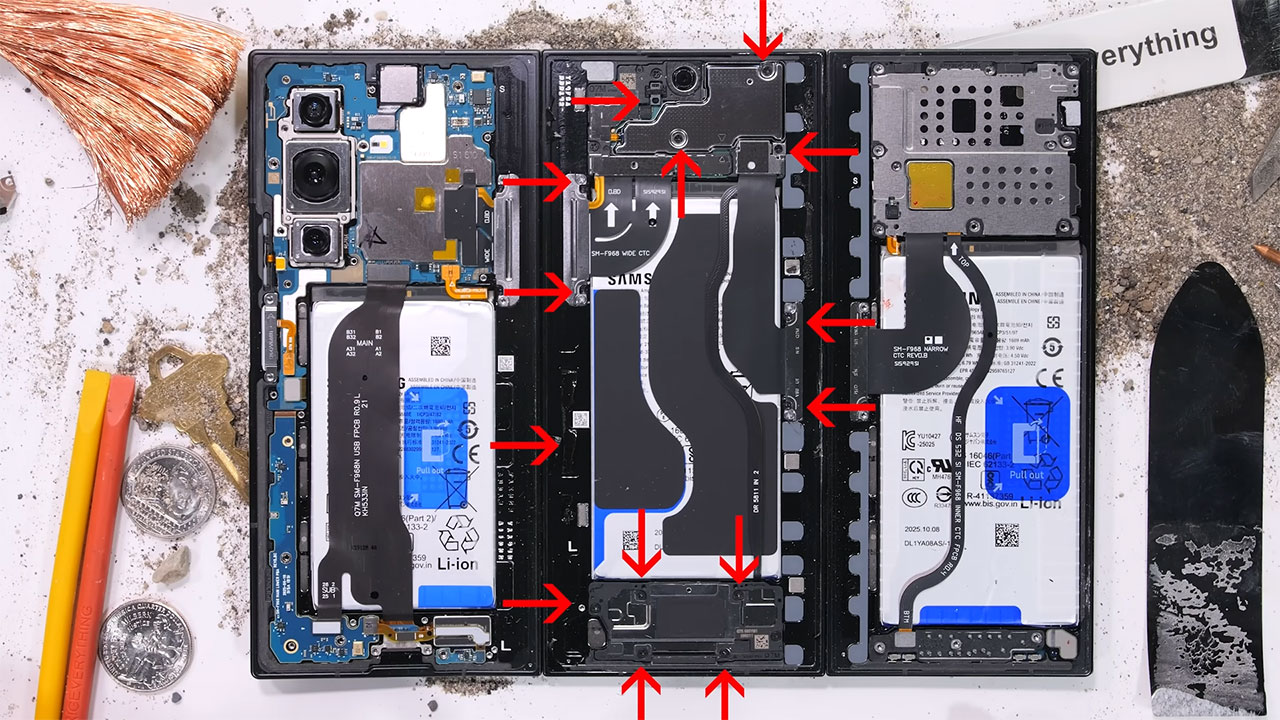
The main motherboard appears to be on the left side next to the camera module, but there are also side boards in the other two sections. I disconnect the long flat cables and pull out the dual SIM tray. The goal here is to get the triple batteries out of the ground so we can calculate how much power they have flowing through them. The middle section has a side board on top that the front-facing camera is still attached to.
Then comes the main board that houses the processor and main cameras. This circuit is where the brains of the phone are, like the Snapdragon 8 Elite. But as usual with Samsung, there’s no silicon paste or even a cooling system; just hoping the aluminum frame will absorb more heat.
I was getting ready to congratulate Samsung on its continued use of those pull tabs. But as you can see, now we have a new problem. The thinness of the batteries makes them practically useless, and the battery bends in a way that really worries me. Maybe that’s why Apple now wraps all its batteries in metal so they don’t bend when you remove them. Bending the battery can cause an explosion, just like we saw with the Pixel Fold earlier this year. Anyway, I’d rather not set anything on fire today, so we’ll just admire the batteries from inside the frame and let them stay in place.
All three batteries of different sizes add up to a whopping 5,600 mAh. Not only is it interesting that each battery section has its own battery, but it’s also interesting that the batteries take up most of the interior space of the phone. The only way phones can get thinner in the future is if battery technology changes dramatically. But for now, Samsung has set a new standard and holds the record for the most functional and beautiful foldable smartphone. The Galaxy Z Trifold’s flexible display itself is similar to what we’ve always seen on foldable phones, with a metal backing on the back and a metal mesh on the curved edges.
And of course, instead of one hinge, Samsung has two. It’s impressive. I’m impressed.
(Buying Guide for the Best Lavalier Microphone on the Market)